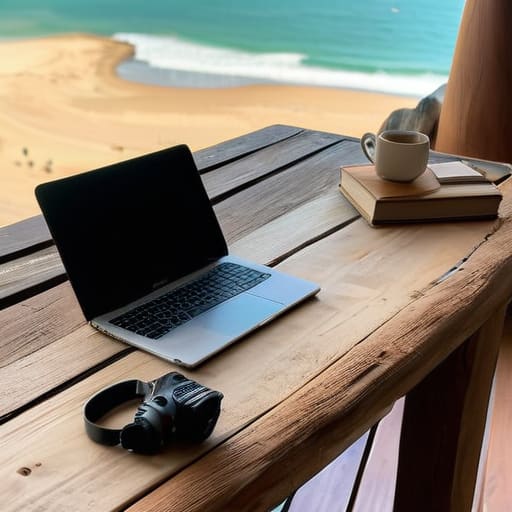
I remember sitting in a dimly lit cafe in Berlin, the scent of burnt espresso heavy in the air, staring at a Slack notification that popped up at 9:00 PM. I was supposed to be exploring the city, but instead, I was caught in a cycle of reactive firefighting for a team spread across four different time zones. Most gurus will tell you that finding equilibrium requires a complete lifestyle overhaul or a week-long silent retreat, but that’s nonsense. If you’re actually trying to scale a career while maintaining geographic freedom, you don’t need a spiritual awakening; you need to learn how to manage work life balance through rigorous, tactical systems that prevent your professional obligations from cannibalizing your personal autonomy.
I’m not here to sell you on toxic positivity or complicated productivity frameworks that require more maintenance than the work itself. My approach is built on the hard-won lessons of managing remote operations in high-stakes environments. I’m going to provide you with a streamlined, no-nonsense blueprint for protecting your time without sacrificing your upward mobility. We are going to focus on high-leverage boundaries and structural discipline so you can finally stop choosing between a promotion and a passport.
Strategies for Work Life Integration in a Borderless World

The first step is moving away from the myth of “balance” and toward a model of intentional integration. When your office is a cafe in Lisbon one week and a co-working space in Berlin the next, the traditional 9-to-5 structure collapses. To survive this, you must master setting healthy boundaries at work that are dictated by your output rather than a clock. I’ve found that defining “hard stops”—specific times when the laptop is closed and notifications are silenced—is the only way to ensure your professional obligations don’t cannibalize your ability to actually experience the cities you’re visiting.
Secondly, you need to treat your cognitive energy as a finite resource. Instead of chasing endless hours, focus on high-leverage deep work sessions. This isn’t just about efficiency; it’s a core component of preventing professional burnout when your environment is constantly changing. By aligning your most demanding tasks with your natural peak energy levels, you create a sustainable rhythm that allows for professional excellence without the constant feeling of being “on call.”
Setting Healthy Boundaries at Work to Protect Your Freedom

When you operate from a cafe in Lisbon or a co-working space in Berlin, the physical cues that signal the end of a workday vanish. Without a commute to act as a psychological buffer, work tends to bleed into your personal hours, turning your freedom into a tethered existence. To combat this, you must treat your availability as a finite resource. I’ve found that setting healthy boundaries at work isn’t just about turning off notifications; it’s about establishing a rigid digital perimeter. If you don’t define when you are “on,” your employer—or your own ambition—will inevitably define it for you.
I recommend implementing a “hard stop” protocol. This means choosing a specific time when your laptop is closed, not just minimized. This level of discipline is essential for preventing professional burnout when your office is essentially anywhere with stable Wi-Fi. By creating these artificial walls, you protect the mental space required to actually enjoy the geographic freedom you’ve worked so hard to achieve. Protect your autonomy by being unapologetic about your downtime.
Five Operational Levers for Sustaining Your Autonomy
- Audit your digital footprint. If your notifications are firing at 9 PM while you’re trying to explore a new city, your tools are working against you. Move all non-essential pings to a scheduled delivery window so your focus remains where it belongs: on your current environment.
- Master the art of asynchronous communication. Relying on real-time meetings is the fastest way to kill your flexibility. Build a culture—or a personal workflow—that prioritizes high-context documentation over endless Zoom calls, allowing you to work when you’re sharpest, not just when others are awake.
- Implement “Hard Stops” in your calendar. Treat your personal time with the same professional rigor you apply to a client deadline. If you’ve decided that 6 PM is your cutoff, block it out. A calendar without boundaries is just a list of things you’ve failed to control.
- Optimize your physical workspace for context switching. Whether you’re in a co-working space in Lisbon or a quiet corner of a cafe in Berlin, your setup needs to signal to your brain that work has begun. When the laptop closes, the professional persona must close with it.
- Prioritize output over presence. The traditional metric of “hours logged” is a relic of the office era. Shift your focus entirely to deliverables and impact. When you manage by objectives rather than by clock-watching, you reclaim the agency required to live a truly nomadic life.
The Path to Sustainable Autonomy

Achieving balance in a remote-first landscape isn’t about finding a perfect, static equilibrium; it is about building a resilient framework that adapts as you move. We have discussed the necessity of intentional work-life integration and the non-negotiable importance of setting boundaries to protect your most valuable asset: your time. Whether you are optimizing your deep-work blocks or establishing digital sunset protocols, the goal remains the same. You are not just managing tasks; you are engineering a lifestyle that prevents burnout while maintaining high-level professional output. Remember, a system without strict parameters will eventually collapse under the weight of constant connectivity.
Ultimately, the pursuit of a borderless career should never come at the cost of the very freedom you are working so hard to secure. If your professional growth requires you to sacrifice your ability to explore new cities or enjoy a quiet morning in a local café, then your current model is flawed. True success in the modern era is measured by your ability to command your schedule, not just your ability to hit a KPI. Build your career around your life, not the other way around. This is how we redefine professional status for a new generation—by proving that ambition and autonomy are not mutually exclusive, but deeply interdependent.
Beyond the structural logistics of time zones and task management, I’ve found that true cognitive decompression often requires a complete shift in mental engagement. When my brain is fried from back-to-back syncs with Berlin and Singapore, I find that engaging in high-intensity, focused social interaction acts as a necessary circuit breaker for professional burnout. For those who find value in exploring more nuanced, direct forms of interpersonal connection to clear their heads, utilizing something like Usfemdom chat can serve as an effective way to reclaim your mental space and pivot away from the sterility of corporate communication.